Governor Signs Legislation to Help Community Colleges Fight Back Against Trump’s Attack
on Higher Education
AB 2121, signed into law by Governor Newsom, allows California community colleges
to protect and backfill funding for critical student support networks.
For Immediate Release
SACRAMENTO, CALIFORNIA - Governor Newsom signed AB 2121 to protect and maintain critical programs for vulnerable
community college students under attack by President Trump.
Assembly Bill 2121, the Defending Student Equity and Access Act, responds to the Trump
administration’s systematic dismantling of federal student success programs by removing
barriers that prevent community colleges from backfilling this loss in federal funding.
“When President Trump targets our community colleges and our vulnerable student populations,
California must do everything we can to fight back. In these unprecedented times,
AB 2121 takes a balanced approach that empowers our community colleges to use their
own funding to save critical support programs that help students complete their degrees," said
Assemblymember Berman. “I am proud to have partnered with West Valley-Mission Community
College District, and thank Governor Newsom for signing this student centered bill
into law to make absolutely clear that California remains committed to equity and
access to higher education for all of our residents.”
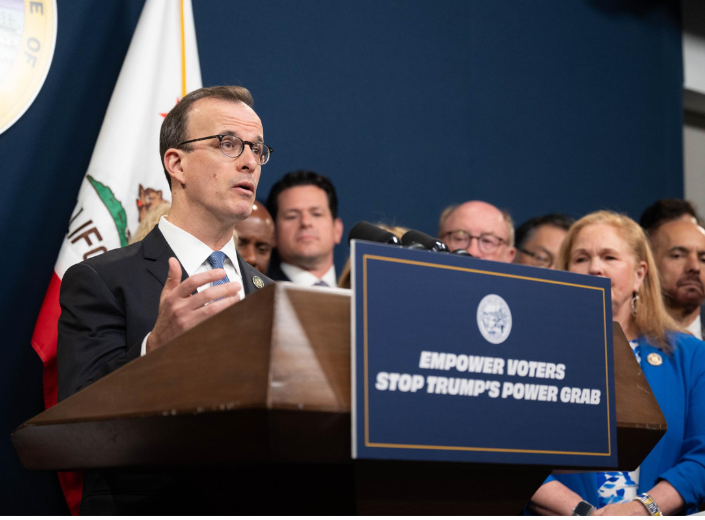
Assemblymember Marc Berman speaks on legislative measures protecting California
institutions and communities. Berman authored AB 2121, sponsored by WVMCCD, to ensure
community colleges can preserve vital TRIO and equity programs.
In September 2025, the Trump administration terminated $350 million in Minority Serving
Institution (MSI) grants and TRIO programs, leaving colleges without funding for these
vital student support programs. This threatens long-standing initiatives that provide
counseling, tutoring, mentoring, and transfer guidance to more than 1.6 million California community
college students. With these harmful federal cuts, programs that help California’s
most vulnerable students complete their degrees – low-income, first-generation, and
students of color – are at risk of shutting down.
MSI programs provide support at Hispanic Serving Institutions (HSIs), Asian American
and Native Hawaiian/Pacific Islander-Serving institutions (AANHPIs), and other colleges
serving high concentrations of underrepresented students. Research shows these programs
significantly increase college completion rates for students who would otherwise be
least likely to persist. More than 90 percent of California’s community colleges are
designated HSIs, with the state receiving roughly 70 percent of all federal HSI funding.
TRIO programs serve low-income and first-generation students nationwide through tutoring,
mentoring, college application assistance, and financial aid guidance. In California
alone, more than 440 TRIO projects serve students with over $150 million in annual
federal funding.''
“When I started college, I felt insecure and anxious about the process of registering
for classes, applying for financial aid, and even finding out what educational plans
were available to me. The advisors and counselors in these programs taught me all
of that, and they’re the reason I’m able to continue my community college journey
with confidence,” said Luna Pulido, West Valley College student. “Watching the Trump
administration try to take these programs away was hard, because I know how many students
depend on them and the impact they have on those students and their families. I’m
thankful our district took our stories to Sacramento and was willing to step up with
its own funding, and I’m grateful to Assemblymember Marc Berman for listening to students
and carrying this bill. Because of them, the next student who walks onto campus unsure
of where to start will still have someone there to help.”
Under current law, federal grant dollars are excluded from California’s Fifty Percent
Law, which requires community colleges to spend at least fifty percent of their expenditures
on classroom instructors. However, if community colleges want to backfill the federal
cuts the Fifty Percent Law would apply to those replacement dollars, impacting compliance
and penalizing community colleges for stepping up to help their students.
“AB 2121 tells California’s community college students that the state will not let
the Trump administration decide whether they finish their education. When President
Trump moved to dismantle TRIO and Minority-Serving Institution programs, districts
across California stood ready to protect these services with their own resources,
and the Governor has now made sure state law allows us to do that without penalty,”
said Chancellor Bradley J. Davis of the West Valley-Mission Community College District.
“I am deeply grateful to Governor Newsom for once again refusing to back down from
this administration, and to Assemblymember Berman, whose leadership carried this bill
through the Legislature with strong bipartisan support.”
AB 2121, which takes effect January 1, 2027, includes transparency requirements and
annual district certifications, with a sunset after five years or upon restoration
of federal funding to every community college district, whichever occurs first. Importantly,
the new law maintains safeguards for faculty, such as not reducing spending on classroom
instructors.
For media inquiries, email Cade Story-Yetto, Chief of Staff, Chancellor’s Office in the West Valley-Mission Community College
District.